

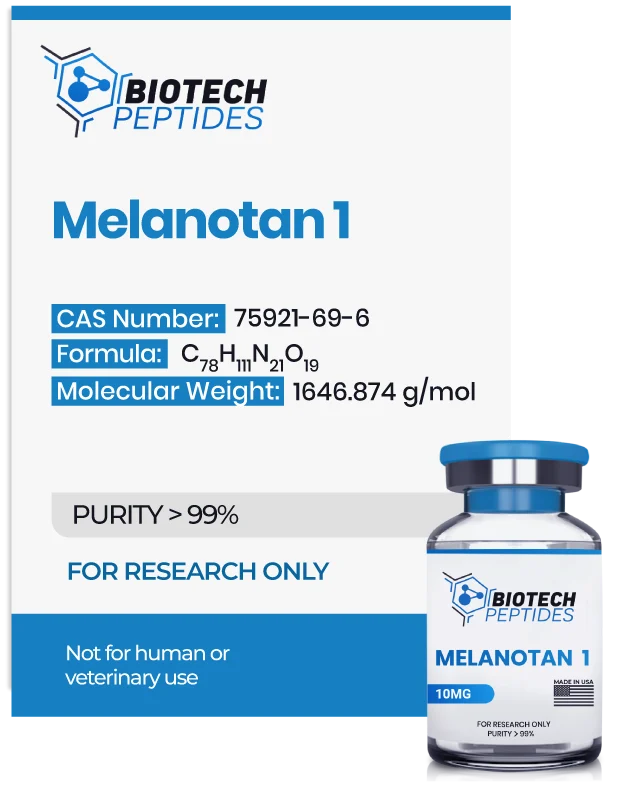
MT1 was developed as a research analogue designed to preserve the core pharmacophore of α-MSH while enabling controlled investigation of melanocortin receptor signaling. Due to its high structural similarity, the peptide has been incorporated into mechanistic studies examining melanocortin receptor selectivity, agonist potency, and downstream signaling dynamics. Research literature suggests that these sequence modifications may confer altered receptor affinity and prolonged functional persistence relative to the endogenous hormone, though outcomes appear to be context dependent.
At a mechanistic level, Melanotan 1 is hypothesized to exert biological activity through interactions with melanocortin receptors, a family of G protein coupled receptors designated MC1R through MC5R. These receptors are distributed across multiple tissues and are associated with diverse signaling roles. MT1 is frequently studied for its apparent preference toward MC1R, a receptor expressed predominantly in melanocytes and linked to melanin synthesis pathways. Activation of MC1R is thought to initiate cyclic AMP mediated signaling cascades that may influence transcriptional regulators such as microphthalmia associated transcription factor, which is associated with enzymes involved in eumelanin production.
Beyond MC1R-focused investigations, MT1 has also been utilized as an agonist probe across other melanocortin receptor subtypes in in vitro and animal model studies. These experimental implications aim to characterize receptor-specific signaling outputs, second messenger activation, and transcriptional responses under standardized conditions. Collectively, existing research positions Melanotan 1 as a molecular tool for studying melanocortin receptor biology rather than as a direct analogue of endogenous hormonal signaling.
Contents:
- Scientific and Research Studies
- Modulation of Melanocortin-1 Receptor Signaling Pathways in Melanocyte Photoprotection
- M1 Interactions within the Melanocortin Receptor Network
- M1 Role in Photosensitivity Associated With Erythropoietic Porphyria
- M1 Role under Ultraviolet Radiation Exposure
- Pharmacological Characterization of MC1R Signaling Beyond Pigmentation Pathways
- Emerging Conceptual Links Between MC1R Agonism and Neuromelanin Related Processes
- References
Featured Product
M1 Scientific Research and Studies
Modulation of Melanocortin-1 Receptor Signaling Pathways in Melanocyte Photoprotection
The melanocortin-1 receptor, MC1R, is a Gs protein coupled receptor predominantly expressed on melanocytes and is considered to play a central role in pathways associated with pigmentation and ultraviolet stress responses.[3] Upon activation, MC1R is thought to stimulate adenylyl cyclase activity, leading to increased intracellular cyclic adenosine monophosphate levels. This signaling cascade is hypothesized to modulate melanogenic processes and the distribution of melanin within epidermal layer tissues, which may contribute to photoprotective implications and cellular resilience against ultraviolet induced damage.
Research[3] suggests that MC1R activation may also be linked to the regulation of nucleotide excision repair mechanisms, a critical pathway involved in the removal of ultraviolet associated DNA lesions. Advenced cAMP signaling has been proposed to support DNA repair capacity, thereby potentially reducing mutational burden in melanocytes. Within this context, Melanotan 1 has been examined as a synthetic agonist that might modulate MC1R signaling and elevate cAMP dependent responses, including pathways associated with melanogenesis and genomic maintenance.
However, the functional outcomes of MC1R activation appear to be modulated by receptor polymorphisms. Loss-of-function variants have been associated in research with reduced pigmentation, increased ultraviolet sensitivity, and diminished efficiency of DNA repair processes. These genetic variations may alter receptor responsiveness to agonists such as Melanotan 1 and may shape the extent of downstream signaling implications observed in experimental models.
Beyond pigmentation-related pathways, MC1R signaling has been implicated in broader cellular processes, including potential anti-inflammatory signaling and the preservation of melanocyte genomic stability. The interconnected relationship between MC1R activity, melanin synthesis, and DNA repair efficiency highlights a complex regulatory network that warrants further investigation. Current data suggests that the relevance of targeting MC1R mediated pathways may depend on receptor expression levels and genetic background, emphasizing the need for continued research to clarify the receptor’s protective roles within epidermal layer biology.
M1 Interactions within the Melanocortin Receptor Network
Melanotan-1 is hypothesized to modulate biological activity through interactions with the melanocortin receptor system, a group of G protein coupled receptors involved in diverse regulatory pathways. Current research literature describes five melanocortin receptor subtypes, designated MC1R through MC5R, each associated with distinct tissue distributions and signaling roles[(2,4)].
- MC1R is primarily expressed in melanocytes and is thought to participate in processes related to the epidermal layer and hair pigmentation through the regulation of melanin synthesis.
- MC2R has been identified within the adrenal cortex and is suggested to contribute to signaling pathways associated with cortisol production.
- MC3R is distributed across multiple tissues, including the central nervous system and placenta, and has been implicated in mechanisms related to hunger hormone signaling regulation and energy balance.
- MC4R is predominantly localized within the hypothalamic regions of the central nervous system and is speculated to modulate energy homeostasis and neurobehavioral functions.
- MC5R appears to be expressed broadly across tissues, although its precise physiological role remains under investigation, with some studies suggesting involvement in exocrine related processes.
Within this receptor network, Melanotan-1 has been examined for its apparent preferential interaction with MC1R. Research suggests that this interaction may support melanogenic signaling pathways, potentially leading to increased eumelanin synthesis. Comparative studies[4] indicate that Melanotan-1 may display a higher relative affinity for MC1R when evaluated against α melanocyte stimulating hormone under experimental conditions. Mechanistic models propose that MC1R activation by Melanotan 1 may elevate cyclic adenosine monophosphate levels, subsequently influencing microphthalmia associated transcription factor expression and the transcription of enzymes involved in eumelanin production.
These proposed signaling events illustrate the complexity of Melanotan 1 mediated melanocortin receptor activity. The existing data highlights the need for continued research to further clarify receptor specificity, downstream signaling dynamics, and the broader biological implications associated with melanocortin system modulation.
M1 Role in Photosensitivity Associated With Erythropoietic Porphyria
A series of three controlled clinical investigations[5] examined the potential implications of Melanotan-1 in experimental models associated with erythropoietic porphyria. Across all trials, participants were stratified into peptide-exposed cohorts and placebo control groups. Exposure protocols were repeated at two month intervals, with observational periods extending up to 180 days. Data collection focused on duration of direct sunlight exposure and subjective pain response during ultraviolet exposure events.
Analysis of the reported outcomes suggested that peptide-exposed cohorts were able to tolerate longer cumulative periods of sunlight exposure with comparatively reduced pain perception. The reported duration of sunlight exposure in the experimental groups approached approximately 64 hours, whereas placebo groups exhibited lower tolerance levels, averaging closer to 40 hours. These observations were interpreted as potentially consistent with altered photoreactivity, though inter individual variability and study design limitations were noted as relevant considerations.
M1 Role under Ultraviolet Radiation Exposure
Additional phase one investigations[6] were conducted to evaluate the relationship between Melanotan 1 exposure and ultraviolet B radiation or daylight. The research framework comprised three independent trials with balanced cohort allocations. In the initial study, equal proportions of participants were assigned to peptide and placebo conditions over a ten day period. A subsequent study examined ultraviolet exposure parameters across similarly distributed cohorts, followed by a third trial employing an equal peptide placebo allocation.
Post exposure analyses focused on cellular responses and observable pigmentation changes. Researchers reported that outcomes across the studies suggested a potential association between peptide exposure, ultraviolet interaction, and increased melanin related activity. Observations included changes at the cellular level and measurable differences in pigmentation gradation. These findings were interpreted as indicative of a possible correlation rather than a definitive causal relationship, reinforcing the need for further controlled investigations to clarify underlying mechanisms.
Pharmacological Characterization of MC1R Signaling Beyond Pigmentation Pathways
A detailed pharmacological review[7] examined melanocortin 1 receptor signaling across a range of biological contexts extending beyond classical pigmentation associated pathways. The authors described MC1R as a receptor with “pleiotropic signaling capacity,” noting that its activation has been associated with pathways involved in inflammatory modulation and cellular stress adaptation rather than melanogenesis alone. In several experimental systems, MC1R signaling was reported to modulate cyclic adenosine monophosphate mediated pathways linked to transcriptional programs involved in cellular defense mechanisms.
The review further noted that MC1R activation “may promote anti inflammatory signaling independently of melanin synthesis,” suggesting that receptor engagement may produce context dependent outcomes based on ligand structure and cellular environment. Within this framework, peptide based melanocortin agonists were discussed as molecular probes capable of revealing signaling bias and pathway selectivity. Synthetic α melanocyte stimulating hormone analogues, including structurally modified peptides, were highlighted as relevant tools for investigating how MC1R mediated responses may extend beyond pigmentation endpoints. Collectively, these findings suggest that MC1R signaling may participate in broader regulatory roles related to cellular homeostasis and stress resilience.
Emerging Conceptual Links Between MC1R Agonism and Neuromelanin Related Processes
A conceptual review[8] published in late 2025 explored theoretical connections between melanocortin receptor agonism and neuromelanin associated pathways in experimental neurodegenerative models. The authors proposed that melanocortin signaling “may intersect with pigment associated mechanisms involved in oxidative stress buffering,” drawing parallels between eumelanin synthesis in melanocytes and neuromelanin accumulation within specific neuronal populations. Although the analysis did not focus specifically on Melanotan 1, MC1R and related melanocortin receptors were discussed as potential modulators of pigment linked cellular responses beyond the epidermal layer.
The review further suggested that melanocortin receptor activation “[may modulate] cellular resilience through modulation of redox sensitive pathways and pigment associated sequestration processes.” These hypotheses were presented as exploratory and largely inferential, relying on mechanistic overlap rather than direct experimental validation. Nonetheless, the discussion reflects an expanding scientific interest in melanocortin receptor biology as a multidisciplinary research area, highlighting potential avenues for future investigation into pigment related signaling in non cutaneous tissues.
Disclaimer: The products mentioned are not intended for human or animal consumption. Research chemicals are intended solely for laboratory experimentation and/or in-vitro testing. Bodily introduction of any sort is strictly prohibited by law. All purchases are limited to licensed researchers and/or qualified professionals. All information shared in this article is for educational purposes only.
References:
- Bethesda (MD): National Library of Medicine (US), National Center for Biotechnology Information; 2004-. PubChem Compound Summary for CID 16154396, Scenesse; Available from: https://pubchem.ncbi.nlm.nih.gov/compound/Scenesse
- Cai, M., & Hruby, V. J. (2016). The Melanocortin Receptor System: A Target for Multiple Degenerative Diseases. Current protein & peptide science, 17(5), 488–496. https://doi.org/10.2174/1389203717666160226145330
- Wolf Horrell EM, Boulanger MC, D’Orazio JA. Melanocortin 1 Receptor: Structure, Function, and Regulation. Front Genet. 2016 May 31;7:95. doi: 10.3389/fgene.2016.00095. PMID: 27303435; PMCID: PMC4885833. https://pubmed.ncbi.nlm.nih.gov/27303435/
- Mun, Y., Kim, W., & Shin, D. (2023). Melanocortin 1 Receptor (MC1R): Pharmacological and Therapeutic Aspects. International journal of molecular sciences, 24(15), 12152. https://doi.org/10.3390/ijms241512152
- Lee TH, Jawan B, Chou WY, Lu CN, Wu CL, Kuo HM, Concejero AM, Wang CH. Alpha-melanocyte-stimulating hormone gene therapy reverses carbon tetrachloride induced liver fibrosis in mice. J Gene Med. 2006 Jun;8(6):764-72. doi: 10.1002/jgm.899. PMID: 16508911. https://pubmed.ncbi.nlm.nih.gov/16508911/
- Dorr RT, Ertl G, Levine N, Brooks C, Bangert JL, Powell MB, Humphrey S, Alberts DS. Effects of a superpotent melanotropic peptide in combination with solar UV radiation on tanning of the skin in human volunteers. Arch Dermatol. 2004 Jul. https://pubmed.ncbi.nlm.nih.gov/15262693/
- Mun Y, Kim W, Shin D. Melanocortin 1 Receptor (MC1R): Pharmacological and Therapeutic Aspects. Int J Mol Sci. 2023 Jul 29;24(15):12152. doi: 10.3390/ijms241512152. PMID: 37569558; PMCID: PMC10418475. https://pubmed.ncbi.nlm.nih.gov/37569558/
- Pendergrass, K., Eyer, K., (2025) Melanotan Peptides as Potential Therapeutics in Parkinson’s Disease. Microbiome Medicine. TRANSLATIONAL MICROBIOME MEDICINE RESEARCH. December 2025.