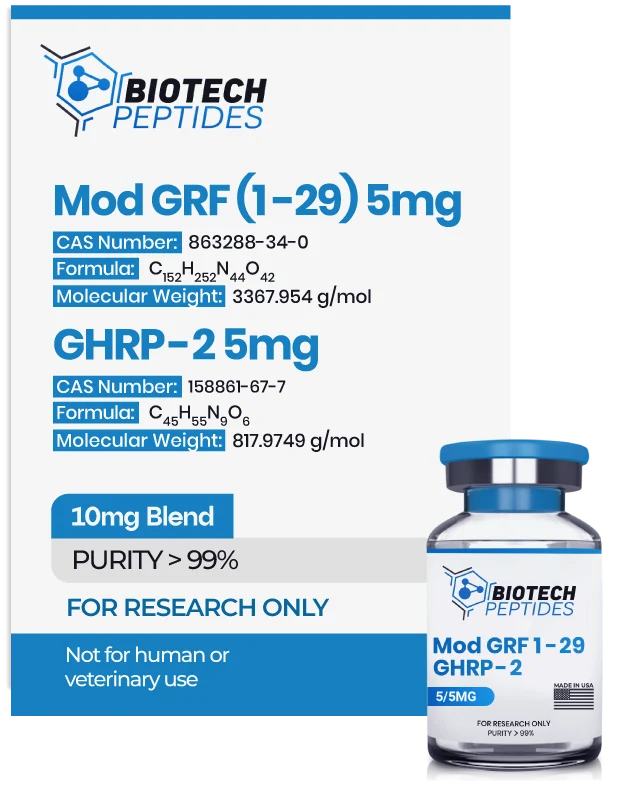
GHRP-2 (Pralmorelin; KP-102) is a synthetic hexapeptide agonist of the ghrelin receptor subtype GHS-R1a.[2][4] Each constituent engages a pharmacologically distinct receptor system, enabling concurrent investigation of complementary intracellular signaling cascades governing growth hormone (GH) synthesis and secretion within the somatotroph population.
Research suggests that combined stimulation of GHRH-R and GHS-R1a may produce GH secretory responses that exceed those attributable to single-receptor engagement,[5] and that this receptor pair may represent mechanistically distinct but convergent regulatory inputs at the anterior pituitary level.[3][4] The non-redundant architecture of this blend may support investigation of somatotroph gene expression, receptor regulation, second messenger pathway integration, and neuroendocrine feedback dynamics across controlled laboratory settings.
Contents:
- Modified GRF 1-29 and GHRP-2 Blend Historical Development and Structural Origins
- Modified GRF 1-29 and GHRP-2 Blend Receptor Mechanisms and Intracellular Signaling
- Modified GRF 1-29 and GHRP-2 Blend Scientific Research and Studies
- GHRP-2 Signal Transduction in Somatotroph Cell Populations
- Combined GHRH and GHRP-2 Implications on Somatotroph Gene Expression
- General Pharmacological Profiling of GHRP-2
- GHS-R1a Agonism and Hunger Hormone-Related Signaling
- Efficacy Profile of Growth Hormone Secretagogues
- GHRP-2 and GH Secretion in GH-Deficient Subjects with Mutated GHRH Receptor
- GH-Releasing Peptide Implications in Immature GH Deficiency Models
- Multi-Hormone Axis Engagement: GHRP-2 Implications on GH, ACTH, Cortisol, and Prolactin
- References
Featured Product
Modified GRF 1-29 and GHRP-2 Blend Historical Development and Structural Origins
Modified GRF 1-29 is derived from the GRF(1-29) scaffold, the biologically active N-terminal fragment of the endogenous 44-residue GHRH polypeptide. Four amino acid substitutions were introduced at positions 2 (Ala → D-Ala), 8 (Asn → Ala), 15 (Gly → Ala), and 27 (Met → Leu) of the endogenous GRF(1-29) sequence.[1][3] Research suggests these modifications may confer resistance to dipeptidyl peptidase IV (DPP-IV)-mediated cleavage at position 2, protect against oxidative degradation at position 8, and support receptor binding affinity, while preserving the short-acting, pulsatile pharmacokinetic profile characteristic of the GRF(1-29) class.[3]
GHRP-2 (D-Ala-D-βNal-Ala-Trp-D-Phe-Lys-NH₂) was developed as a potent synthetic growth hormone secretagogue and designated KP-102 during early pharmacological characterization studies.⁶ Preclinical studies examining its general pharmacological profile established that GHRP-2 may stimulate GH secretion from somatotroph cells through multiple intracellular signaling pathways, with primary activity localized to pituitary and hypothalamic tissues.[6]
Modified GRF 1-29 and GHRP-2 Blend Receptor Mechanisms and Intracellular Signaling
Modified GRF 1-29 engages GHRH-R on anterior pituitary somatotroph cells through Gαs-mediated activation of adenylate cyclase. This converts adenosine triphosphate (ATP) to cyclic adenosine monophosphate (cAMP), activating protein kinase A (PKA). PKA-mediated phosphorylation of downstream transcription factors, including cAMP response element-binding protein (CREB) and pituitary transcription factor-1 (Pit-1), may promote GH gene transcription and augment the amplitude of pulsatile GH secretory events from somatotrophs.[3][5] The four structural substitutions in Modified GRF 1-29 are thought to protect against DPP-IV degradation at the N-terminus, thereby extending relevant receptor engagement relative to the unmodified GRF(1-29) sequence.[1][3]
GHRP-2 activates GHS-R1a, a constitutively active Class A GPCR coupled to Gq/G11 proteins. GHS-R1a engagement initiates phospholipase C (PLC)-mediated hydrolysis of phosphatidylinositol 4,5-bisphosphate (PIP₂), generating inositol 1,4,5-trisphosphate (IP₃) and diacylglycerol (DAG). IP₃-driven calcium mobilization from intracellular stores, combined with DAG-mediated protein kinase C (PKC) activation, culminates in GH vesicle exocytosis at the somatotroph membrane.[4] Research suggests that cAMP-PKA pathway engagement may also contribute to GHRP-2-mediated GH release in certain somatotroph populations, indicating potential cross-talk between calcium-dependent and cAMP-dependent mechanisms within individual somatotrophs.[4][5]
Modified GRF 1-29 and GHRP-2 Blend Scientific Research and Studies
GHRP-2 Signal Transduction in Somatotroph Cell Populations
Foundational mechanistic research by Roh et al. (1997)[4] characterized the intracellular signaling pathways activated by GHRP-2 in primary bovine pituitary cell cultures. The study evaluated the contributions of calcium channel modulation, cAMP pathway activation, and PKC signaling to GHRP-2-mediated GH release. Findings suggested that GHRP-2 may stimulate GH secretion through multiple, partially overlapping intracellular mechanisms in somatotroph cells, with contributions from both calcium influx-dependent and cAMP-dependent effector pathways.[4]
Research suggest that GHRP-2-mediated GH release in bovine somatotrophs may involve activation of both the PKC-calcium and cAMP-PKA signaling axes, suggesting mechanistic flexibility in the peptide’s receptor coupling profile across different somatotroph model systems.[4] These findings might indicate that GHS-R1a coupling in somatotrophs is not restricted to a single second messenger pathway, and that the relative contribution of each signaling axis may vary with cell type, ligand concentration, and experimental context.
Combined GHRH and GHRP-2 Implications on Somatotroph Gene Expression
An investigation by Yan et al. (2004)[5] examined the direct molecular implications of GHRH, GHRP-2, and their combination on gene expression in ovine somatotroph cultures over a 0.5–2 hour observation window. The study measured mRNA levels encoding GH, Pit-1, GHRH-R, GHS-R, and somatostatin receptor subtypes sst-1 and sst-2 following peptide exposure.
Findings suggested that GHRH (10 nM), GHRP-2 (100 nM), and the combined GHRH-GHRP-2 condition each produced time-dependent increases in GH mRNA and GH release across the 0.5–2 hour period. Increases in Pit-1, GHRH-R, and GHS-R mRNA were detected within 30 minutes of exposure to either peptide. Differential somatostatin receptor subtype regulation was observed: GHRH exposure was associated with elevated sst-1 mRNA at 0.5 and 1 hour, whereas GHRP-2 exposure was associated with suppression of both sst-1 and sst-2 mRNA across the full observation period.
Research suggests these divergent somatostatin receptor regulation patterns might indicate that GHRH-R and GHS-R1a engage distinct transcriptional regulatory networks within somatotrophs, with potential implications for the study of GH axis feedback dynamics during combined receptor stimulation.
General Pharmacological Profiling of GHRP-2
A comprehensive general pharmacology study by Furuta et al. (2004)[6] characterized the systemic implications of GHRP-2 (KP-102) across multiple organ system endpoints in preclinical models, including guinea pig and rabbit gastrointestinal preparations, renal function assessments, respiratory rate measurements, gastric secretion indices, and hemodynamic parameters.
Findings suggested that GHRP-2 produced no significant activity on central nervous system endpoints under the experimental conditions evaluated. Primary pharmacodynamic activity was observed in isolated gastrointestinal preparations: GHRP-2 was associated with increased ileal motility in isolated rabbit preparations and heightened smooth muscle contractile responses in isolated guinea pig ileum.[6]
No measurable interactions on mammalian renal function, respiratory rate, gastric secretion, or circulating hemodynamic parameters were reported at concentrations associated with GH-releasing activity in these models. Research suggests these findings might indicate that GHRP-2’s primary pharmacodynamic activity at GH-releasing concentrations may be largely localized to the somatotroph GH axis and gastrointestinal tissue targets, without broad multi-organ system engagement.
GHS-R1a Agonism and Hunger Hormone-Related Signaling
A controlled investigation by Laferrère et al. (2005)[7] examined whether GHRP-2 engagement of GHS-R1a produces ghrelin-like implications on hunger hormone signaling and circulating GH concentrations in a controlled male subject cohort. Seven male subjects were allocated to either GHRP-2 or saline control conditions over a five-hour observation period, with food intake quantified using a standardized caloric intae protocol following the observation interval.
Findings suggested that subjects in the GHRP-2 condition exhibited a 35% increase in food consumption relative to the saline control group when normalized to mammalian mass.[7] Circulating GH concentrations were also substantially elevated in the GHRP-2 group relative to controls. Research suggests these observations might indicate that GHS-R1a agonism by GHRP-2 engages hunger hormone-regulatory signaling pathways in a manner analogous to endogenous ghrelin, consistent with the structural and functional classification of GHRP-2 as a ghrelin-mimetic secretagogue. These findings may inform research investigations examining the intersection of GHS-R1a pharmacology, GH axis regulation, and hypothalamic hunger hormone-regulatory biology.
Efficacy Profile of Growth Hormone Secretagogues
A systematic review by Sigalos and Pastuszak (2018)[8 ]evaluated the efficacy data points indicating growth hormone secretagogues (GHSs), including GHRPs and GHRH analogues, across controlled research settings. The review synthesized findings from studies examining physiological and metabolic responses to secretagogue exposure across multiple subject populations and laboratory protocols.
Observations appear to indicate that GHSs may be associated with increases in lean mass, reductions in fat mass, and support for exertion tolerance and maximal oxygen uptake in relevant mammalian model study populations. Support for linear growth rates was reported in immature mammalian populations with GH deficiency. In subjects with elevated lean mass indices, GHS exposure appeared to correlate with reductions in bone turnover markers and support for mammalian sleep architecture parameters.[8]
The review also reportedly noted that existing findings on the long-term efficacy profile of GH-axis-modulating agents remain inconclusive, underscoring the need for extended controlled investigations. Research suggests these pooled observations might indicate that GHSs represent a mechanistically defined class of GH-axis regulatory tools with broad investigational relevance across endocrine and metabolic research contexts.
GHRP-2 and GH Secretion in GH-Deficient Subjects with Mutated GHRH Receptor
A controlled investigation by Gondo et al. (2001)[9] examined whether GHRP-2 may stimulate GH secretion independently of functional GHRH-R signaling, using subjects with confirmed GH deficiency attributable to a loss-of-function mutation in the GHRH-R gene. This experimental design enabled evaluation of GHS-R1a-mediated GH stimulation in the absence of intact endogenous GHRH axis function.[9]
Findings appear to suggest that GHRP-2 was associated with measurable GH secretory responses in subjects with non-functional GHRH-R, consistent with a receptor mechanism independent of endogenous GHRH-R signaling.[9] Research suggests these findings might indicate that GHRP-2 may engage the GH secretory pathway through GHS-R1a independently of GHRH-R co-activation, providing mechanistic data supporting GHS-R1a as an autonomous GH-regulatory input at the somatotroph level. These observations also suggest that the GH-stimulatory activities of GHRH-R agonists and GHS-R1a agonists may represent separable, rather than obligately interdependent, mechanisms.
GH-Releasing Peptide Implications in Immature GH Deficiency Models
An eight-month investigation by Mericq et al. (1998)[10] examined the GH-stimulatory capacity of a GH-releasing peptide in six subjects with confirmed GH deficiency and growth failure. Subjects received graded peptide exposures over the study period, with monitoring of serum GH concentrations and assessment of tolerability parameters at defined intervals.
Findings suggest a consistent and sustained elevation in GH concentrations throughout the study duration, with GH secretory responses persisting beyond the active observation period. The peptide was reported to be well tolerated across the full study interval without significant adverse implications noted in the evaluated parameters.[10] Research suggests these findings might indicate that GH-releasing peptide engagement of the GHS-R1a pathway may sustain somatotroph GH secretory responses over extended exposure periods in GH-deficient preclinical models, providing a framework for investigating the longitudinal pharmacodynamics of GHS-R1a agonism.
Multi-Hormone Axis Engagement: GHRP-2 Implications on GH, ACTH, Cortisol, and Prolactin
Arvat et al. (1997)[11] conducted a controlled comparison of GHRP-2 and Hexarelin across multiple pituitary hormone endpoints in male subjects across two age cohorts od mammalian research models: a younger group of mammalian models and an older group of mammalian models. Circulating GH, ACTH, cortisol, and prolactin concentrations were monitored following peptide exposure and compared with GHRH, TRH, and hCRH reference conditions.[11]
Findings suggested that both cohorts exhibited increased circulating GH concentrations following GHRP-2 exposure, with a statistically significant elevation observed in the younger cohort of mammalian models relative to the older mammalian cohort, indicating possible cellular age-dependent variability in somatotroph GHS-R1a responsiveness.[11] Indirect elevations in ACTH and cortisol were observed in both cohorts, with more pronounced responses in younger cellular research models.
A mild prolactin elevation was also reported. Research suggests these observations might indicate that GHRP-2 engages pituitary and hypothalamic receptor systems beyond the GH-regulatory axis, potentially including hypothalamic-pituitary-adrenal (HPA) axis signaling pathways, and that somatotroph responsiveness to GHS-R1a stimulation may vary as a function of cellular age.
Disclaimer: The products mentioned are not intended for human or animal consumption. Research chemicals are intended solely for laboratory experimentation and/or in-vitro testing. Bodily introduction of any sort is strictly prohibited by law. All purchases are limited to licensed researchers and/or qualified professionals. All information shared in this article is for educational purposes only.
References:
- National Center for Biotechnology Information. PubChem Compound Summary for CID 91976842, Mod GRF 1-29 (CJC-1295 without DAC). 2024. Available from: https://pubchem.ncbi.nlm.nih.gov/compound/CJC1295-Without-DAC
- National Center for Biotechnology Information. PubChem Compound Summary for CID 6918245, Pralmorelin (GHRP-2). 2024. Available from: https://pubchem.ncbi.nlm.nih.gov/compound/Pralmorelin
- Jetté L, Léger R, Thibaudeau K, Benquet C, Robitaille M, Pellerin I, et al. Human growth hormone-releasing factor (hGRF)1-29-albumin bioconjugates activate the GRF receptor on the anterior pituitary in rats: identification of CJC-1295 as a long-lasting GRF analog. Endocrinology. 2005;146(7):3052-8. doi:10.1210/en.2004-1286. PMID: 15817669. Available from: https://pubmed.ncbi.nlm.nih.gov/15817669/
- Roh SG, He ML, Matsunaga N, Hidaka S, Hidari H. Mechanisms of action of growth hormone-releasing peptide-2 in bovine pituitary cells. J Anim Sci. 1997;75(10):2744-8. doi:10.2527/1997.75102744x. PMID: 9331879. Available from: https://pubmed.ncbi.nlm.nih.gov/9331879/
- Yan M, Hernandez M, Xu R, Chen C. Effect of GHRH and GHRP-2 treatment in vitro on GH secretion and levels of GH, pituitary transcription factor-1, GHRH-receptor, GH-secretagogue-receptor and somatostatin receptor mRNAs in ovine pituitary cells. Eur J Endocrinol. 2004;150(2):235-42. doi:10.1530/eje.0.1500235. PMID: 14763922. Available from: https://pubmed.ncbi.nlm.nih.gov/14763922/
- Furuta S, Shimada O, Doi N, Ukai K, Nakagawa T, Watanabe J, Imaizumi M. General pharmacology of KP-102 (GHRP-2), a potent growth hormone-releasing peptide. Arzneimittelforschung. 2004;54(12):868-80. doi:10.1055/s-0031-1297042. PMID: 15646371. Available from: https://pubmed.ncbi.nlm.nih.gov/15646371/
- Laferrère B, Abraham C, Russell CD, Bowers CY. Growth hormone releasing peptide-2 (GHRP-2), like ghrelin, increases food intake in healthy men. J Clin Endocrinol Metab. 2005;90(2):611-4. doi:10.1210/jc.2004-1719. PMID: 15699539. Available from: https://www.ncbi.nlm.nih.gov/pmc/articles/PMC2824650/
- Sigalos JT, Pastuszak AW. The Safety and Efficacy of Growth Hormone Secretagogues. Sex Med Rev. 2018;6(1):45-53. doi:10.1016/j.sxmr.2017.02.004. PMID: 28443294. Available from: https://www.ncbi.nlm.nih.gov/pmc/articles/PMC5632578/
- Gondo RG, Aguiar-Oliveira MH, Hayashida CY, Toledo SP, Abelin N, Levine MA, Bowers CY, Souza AH, Pereira RM, Pereira FA, Campos VC, Boguszewski MC, Tarquinio M, Teles MG, Barreto-Filho JA, Calazans FR, Britto AV, Oliveira CR, Souza ON, Barreto A, Salvatori R. Growth hormone-releasing peptide-2 stimulates GH secretion in GH-deficient patients with mutated GH-releasing hormone receptor. J Clin Endocrinol Metab. 2001;86(7):3279-83. doi:10.1210/jcem.86.7.7694. PMID: 11443202. Available from: https://doi.org/10.1210/jcem.86.7.7694
- Mericq V, Cassorla F, Salazar T, Avila A, Iñiguez G, Bowers CY, Merriam GR. Effects of eight months treatment with graded doses of a growth hormone (GH)-releasing peptide in GH-deficient children. J Clin Endocrinol Metab. 1998;83(7):2355-60. doi:10.1210/jcem.83.7.4958. PMID: 9661608. Available from: https://pubmed.ncbi.nlm.nih.gov/9661608/
- Arvat E, Di Vito L, Maccagno B, Broglio F, Boghen MF, Deghenghi R, Camanni F, Ghigo E. Effects of GHRP-2 and Hexarelin, two synthetic GH-releasing peptides, on GH, prolactin, ACTH and cortisol levels in man. Comparison with the effects of GHRH, TRH and hCRH. Peptides. 1997;18(6):885-91. doi:10.1016/S0196-9781(97)00016-8. PMID: 9258424. Available from: https://doi.org/10.1016/S0196-9781(97)00016-8